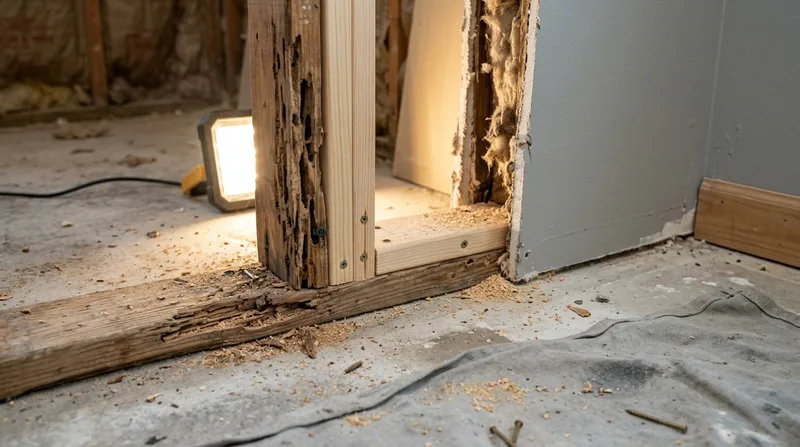




Termite damage repair in Fort Lauderdale is a structural carpentry priority in our subtropical climate, where drywood termites nest year-round in attics and trim, and Formosan and Asian subterranean termites move up from the ground into sill plates, rim joists and subfloor sections. After your pest control contractor treats an infestation, the damaged wood remains, and that wood must be replaced to restore full structural integrity. We remove termite-eaten studs, plates, joists, trim and framing members, working from your pest inspection report, and rebuild the damaged sections with new pressure-treated or solid wood. The 1910s-30s frame cottages of Sailboat Bend and Rio Vista, the 1940s-50s masonry bungalows of Victoria Park, and the mid-century ranches of Coral Ridge all face this problem year-round. Unlike generic handyman work, we replace the wood, not just patch it, and we explain what failed and why so you understand the repair.
Why Termite Damage Repair Matters in Fort Lauderdale's Hot, Humid Climate
South Florida's year-round warmth and humidity create perfect conditions for termite colonies. Drywood termites thrive inside wood framing without soil contact, establishing hidden galleries in attics, trim and door frames. Formosan and Asian subterranean termites move upward through the ground and into sill plates and floor joists, weakening the structural members that carry your home's weight. Once a pest inspector identifies an infestation, treatment eliminates the colony, but the tunneled wood stays compromised. Leaving damaged framing in place risks settling, soft spots in floors, and eventual failure of load-bearing members.
- We remove studs, plates and joists that have lost structural capacity to termite galleries and replace them with new pressure-treated or solid lumber.
- We splice new rim joists and sill plates where termite damage has undercut the foundation connection, restoring full bearing.
- We replace subfloor sections and floor joists that show soft spots or hollow channels, eliminating springy or sagging floors.
- We restore trim, fascia and door jambs damaged by drywood termites, matching the original profile and finish.
Repairing termite damage promptly prevents secondary rot, mold growth and further structural decline in Fort Lauderdale's damp environment.
Key info: In Victoria Park and Middle River Terrace, 1940s-50s masonry bungalows often hide termite damage in the wood sill plates and rim joists that sit on the concrete foundation. We remove and replace these members without disturbing the masonry, restoring structural integrity and preventing further wood loss.
For detailed guidance on what to expect from a pest inspection report and how to choose a contractor for follow-up repairs, visit the Wood Rot & Dry Rot Repair page, which covers similar structural pathologies and repair methods.
How We Repair Termite Damage: Step-by-Step Process in Fort Lauderdale
We start with your pest inspection report, which identifies the extent and location of termite galleries and damaged wood. Our approach is to remove only the compromised sections, not the entire member, whenever sound wood remains on either side. We measure and cut new pressure-treated lumber to match the original dimensions, scarf-joint or butt-join the replacement section to the existing frame, and secure it with structural fasteners and adhesive. For trim and fascia, we match the original profile and finish. For floor joists and subfloor, we sister a new joist alongside the damaged one, or replace the section in place, depending on access and the scope of the damage.
- We inspect the damage on site, photograph the galleries and soft spots, and confirm the scope with you before estimating.
- We remove the damaged wood carefully, preserving any sound material and the surrounding structure.
- We cut and fit new pressure-treated lumber, matching the original species and dimensions where load-bearing capacity is critical.
- We join new and existing wood with structural fasteners, adhesive and, where needed, sister joists to restore full load capacity.
- We finish and paint or stain the new wood to match the original, or leave it in a natural state depending on the location and your preference.
The repair is complete when the new wood is structurally sound, properly fastened and finished to match the surrounding frame.
Example: A Coral Ridge mid-century ranch with exposed rafter tails and deep eaves had drywood termite galleries in the soffit framing and rafter tails. We removed the damaged sections of soffit and rafter, cut new redwood to match the original profile, sistered new joists where needed, and finished the repair to blend with the existing eaves. The homeowner was able to keep the original architectural character while restoring full structural integrity.
For information on how we handle more complex structural repairs involving floor joists and subfloors, see Floor Joist & Subfloor Repair.
Termite Damage Repair Methods and Techniques
| Approach | Description | Best for |
|---|---|---|
| Partial section replacement | Remove only the tunneled portion of a stud, joist or plate, cut new lumber to match, and scarf-joint or butt-join the new piece to the sound wood on either side. | Studs, plates, trim and fascia where damage is localized and sound wood remains on both sides. |
| Sistering | Install a new pressure-treated joist or beam alongside the damaged one, fastening them together with bolts and structural adhesive to act as a single composite member. | Floor joists and rim joists where the original member is too compromised to repair but must remain in place. |
| Full member replacement | Remove the entire damaged joist, beam or stud and install a new pressure-treated or solid lumber member, properly sized and supported. | Sill plates, rim joists and major structural members where damage extends the full depth or length of the wood. |
| Subfloor patching | Remove soft or hollow subfloor sections, inspect the joists below, repair or sister joists as needed, and install new subfloor material to match the original thickness and species. | Subfloor damage where termites have tunneled through the decking and joists, causing soft spots or springy floors. |
Termite Damage Repair Cost in Fort Lauderdale: What to Expect
Termite damage repair costs in Fort Lauderdale start at $1,200 for small, localized repairs such as replacing a single damaged stud or trim member in an accessible location. Larger jobs involving multiple joists, sill plates or subfloor sections typically run $3,000 to $8,000 depending on the extent of the damage, the number of members affected and whether access requires removing drywall or flooring. The primary cost drivers are the linear feet of wood that must be replaced, the species and grade of replacement lumber needed, and the labor hours required to remove, fit and finish the new wood. Jobs involving structural members such as rim joists or load-bearing studs may require a structural engineer's assessment before repair begins, which adds cost but ensures the repair meets code and restores full load capacity.
We recommend getting two or three estimates from local carpenters so you can compare scope, materials and labor. A detailed estimate will specify which members are being replaced, what material will be used, and whether any structural engineering or permits are needed. See our pricing page for a full breakdown of typical repair costs by scope and complexity.
Termite Damage Repair Near Me: What Fort Lauderdale Homeowners Should Know When Hiring a Carpenter
When you hire a carpenter for termite damage repair, verify that they have a clear understanding of structural carpentry and can explain the repair method before starting work. Ask to see references from recent termite damage repairs, not just general carpentry jobs. Confirm that the contractor is fully insured and can provide a certificate of insurance on request. For repairs involving structural members such as sill plates, rim joists or load-bearing studs, ask whether the scope requires a structural engineer's input or a building permit; requirements vary by the extent of the work and your local building department's thresholds, so verify with your city or county before signing a contract. If your home is in a historic district or subject to HOA rules, check whether there are restrictions on the materials or methods you can use for the repair.
- Request a detailed, written estimate that lists each member being repaired, the material being used and the labor involved.
- Ask the contractor to explain the repair method and why it is appropriate for your specific damage pattern.
- Check references from homeowners who had similar termite damage repairs completed in the past 12 months.
- Confirm that the contractor can obtain any required permits and coordinate with your local building department if structural work is involved.
- Verify that your homeowner's insurance will cover the repair, and ask whether the contractor can help document the damage for your claim.
For a free estimate and to discuss your specific termite damage repair needs, contact us at (754) 354-7735. We respond within 24 hours and provide a detailed scope and estimate at no obligation.
Termite Damage Repair in Fort Lauderdale: Pricing Guide
| Service | Price | Details |
|---|---|---|
| Small localized repair (single stud, trim or fascia section) | Starting at $1,200 | Replacement of one damaged member in an accessible location, including material, labor and finish work. |
| Medium repair (multiple studs, trim sections or subfloor patch) | Starting at $3,000 | Replacement of 2-4 damaged members, partial subfloor removal and replacement, or sill plate repair in accessible areas. |
| Large structural repair (rim joist, multiple joists, extensive subfloor) | Starting at $5,000 | Full rim joist replacement, sistering multiple floor joists, extensive subfloor patching or repairs requiring temporary support or access work. |
| Complex or extensive termite damage requiring structural engineering | On estimate | Damage affecting multiple structural members, requiring engineer assessment, or involving load-bearing wall components needs site inspection before pricing. |
| Travel | Included | No separate call-out or mileage fee in Fort Lauderdale and surrounding areas throughout Broward County. |
| Free estimate | No charge | Response within 24 hours at (754) 354-7735, no obligation to book, includes scope and pricing guidance. |
Indicative pricing, the exact cost depends on square footage, finish, and site access. Free personalized estimate within 24h at (754) 354-7735.


